
Vernon Hills Directory Collections
No official source located a complete, dedicated Vernon Hills city directory run. The Village incorporated in 1958, so early entries may be filed under Chicago Suburban North, Libertyville, Mundelein, Half Day, or another postal or exchange label. The useful collection is therefore a network of telephone books, local-history shelves, indexes, maps, newspapers, and archival records.
| Collection | Years | Where Held | Access |
|---|---|---|---|
| Chicago Suburban North telephone books | 1959/60, 1969, 1971-72, 1973 catalog items | Library of Congress | Online catalog; exact Vernon Hills pages need manual review |
| City directories and Illinois Collection | Runs vary | Waukegan Public Library | Library shelves, databases, microfilm, staff request |
| Lake County genealogy collection | Multiple series, 1839 onward | LCIGS, 290 Evergreen Drive | Volunteer research room and FamilySearch Affiliate access |
| Maps, manuscripts, ledgers, yearbooks | Collection-specific | Waukegan Historical Society | Planned visit; appointment recommended |
| Plats, school records, photos, postcards | 1841 onward in listed series | Lake County History Archives, Dunn Museum | Repository inquiry or appointment |
A catalog year only proves that a volume exists. It does not prove that Vernon Hills has its own heading or that a named household appears. Record the catalog ID and unresolved coverage gap before drawing a conclusion.
Vernon Hills Directories After 1958
The official Village history places incorporation on July 16, 1958, after the community began as a 125-house subdivision. That date explains why a pre-incorporation directory search should not insist on the Vernon Hills label. Early municipal work also moved through a motel lobby and the clerk's home before a stable office system developed.
For an early address, search the wider suburban title and nearby locality names. Pair the directory year with a landowner map, deed, newspaper notice, or census. The city directory result must retain its printed geographic label rather than silently converting it to today's Village name.
Vernon Hills Genealogy Room
The Lake County Illinois Genealogical Society research room sits in the former Village Hall at 290 Evergreen Drive. Volunteers list weekday hours from 9:00 a.m. to 4:45 p.m., but visitors should call 847-918-3584 because staffing controls access. The same address links current Village administration with the strongest nearby genealogy shelf.
LCIGS reports more than 6,000 books, 54 cemetery transcriptions, and an obituary and cemetery-card file exceeding 250,000 items. Its holdings include census transcriptions, naturalizations, probate, court files, landowner maps, yearbooks, family histories, and microfilm. These sources can identify and separate names around a directory entry.

The captured hours page shows the local in-person route, which matters when a city directory or microfilm is not indexed online.
The Society's Lake County collection inventory sets out the record groups that can test a directory entry.
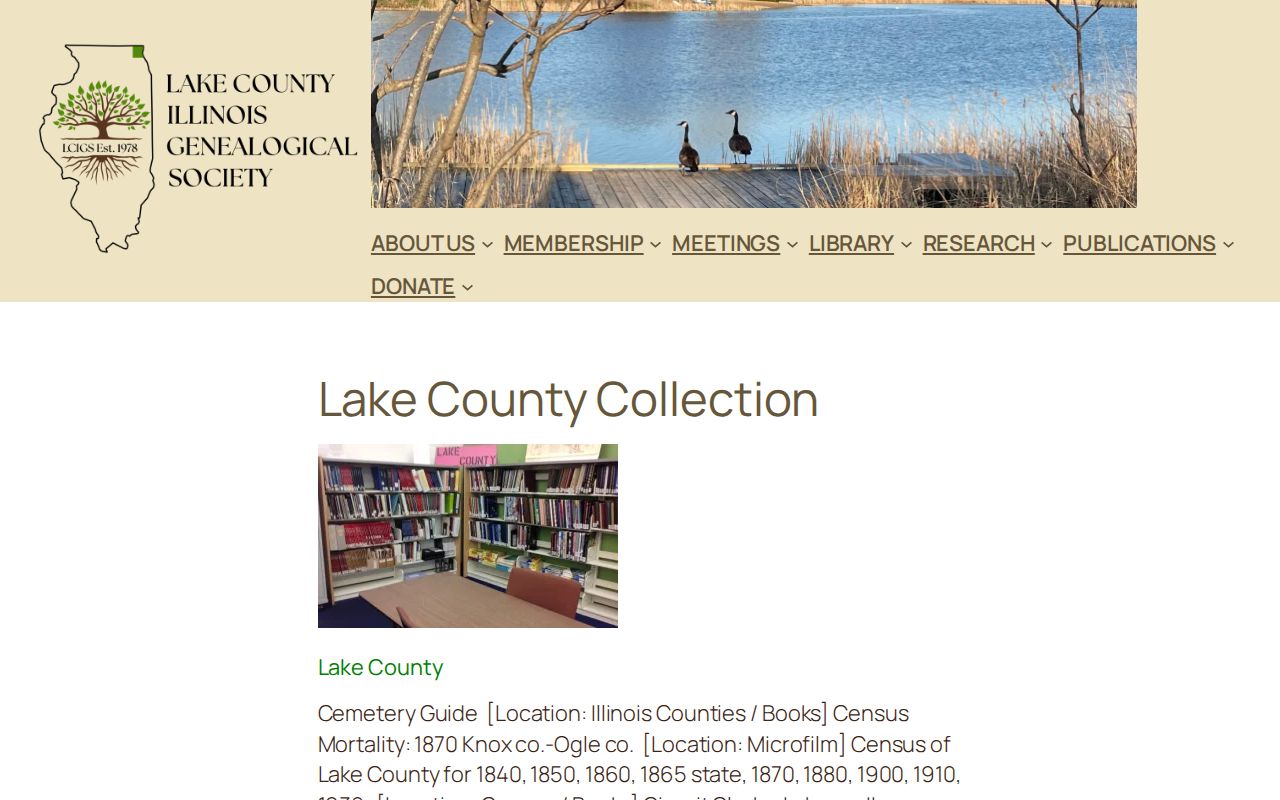
The collection capture helps researchers choose a dated census, map, probate, cemetery, or newspaper source instead of guessing from one line.
Read Vernon Hills Directory Entries
No directory page was successfully opened during the research capture, so the fields below are a transcription checklist, not an asserted local sample. Photograph or note the title page and abbreviation key before copying a line. That context is essential when initials, exchange names, or short forms are unclear.
| Edition | Printed title, publisher, year, area label, and page |
|---|---|
| Name | Exact spelling, initials, business label, and cross-reference |
| Address and phone | Street text, unit if shown, exchange, and telephone number |
| Entry notes | Advertisement, reverse listing, or other printed context |
- Criss-cross directory
- A volume or section ordered by street and address, used to find a dated listing from a place.
- Householder index
- An address-oriented list of the named householder or subscriber, not every person in the household.
- Abbreviation key
- The publisher's legend for initials and shortened terms. Save it because meanings vary by edition.
Treat the line as a dated snapshot. An omitted name can reflect an unlisted number, a different locality label, a missing volume, or a move. It is not proof of absence.
Waukegan's City Directory Stack
The Waukegan Public Library local-history collection identifies city directories, yearbooks, local authors, and Illinois materials. Its genealogy service adds Ancestry Library Edition, HeritageQuest, Chicago Tribune scans, Lake County News-Sun coverage, older local newspaper microfilm, and an obituary lookup.
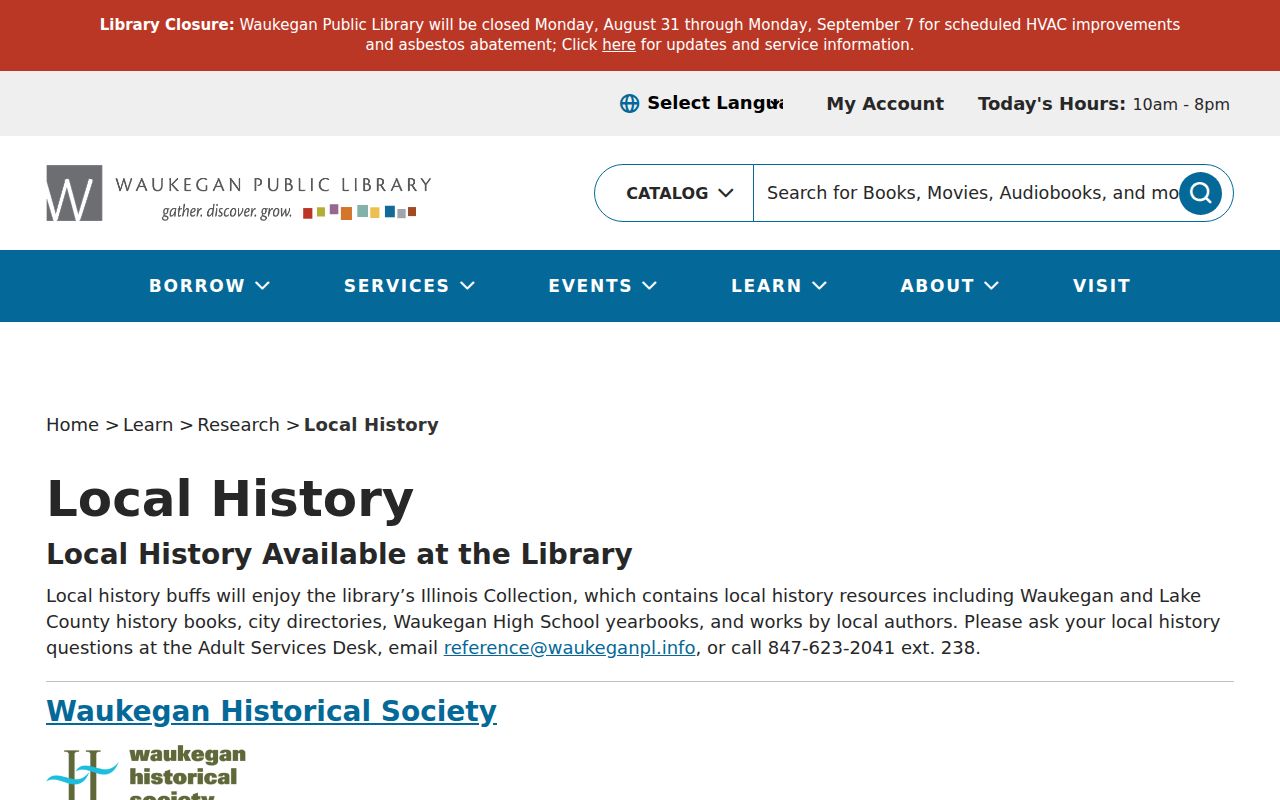
The local-history capture identifies the nearby shelf to ask about when a Vernon Hills label is missing from an online catalog.
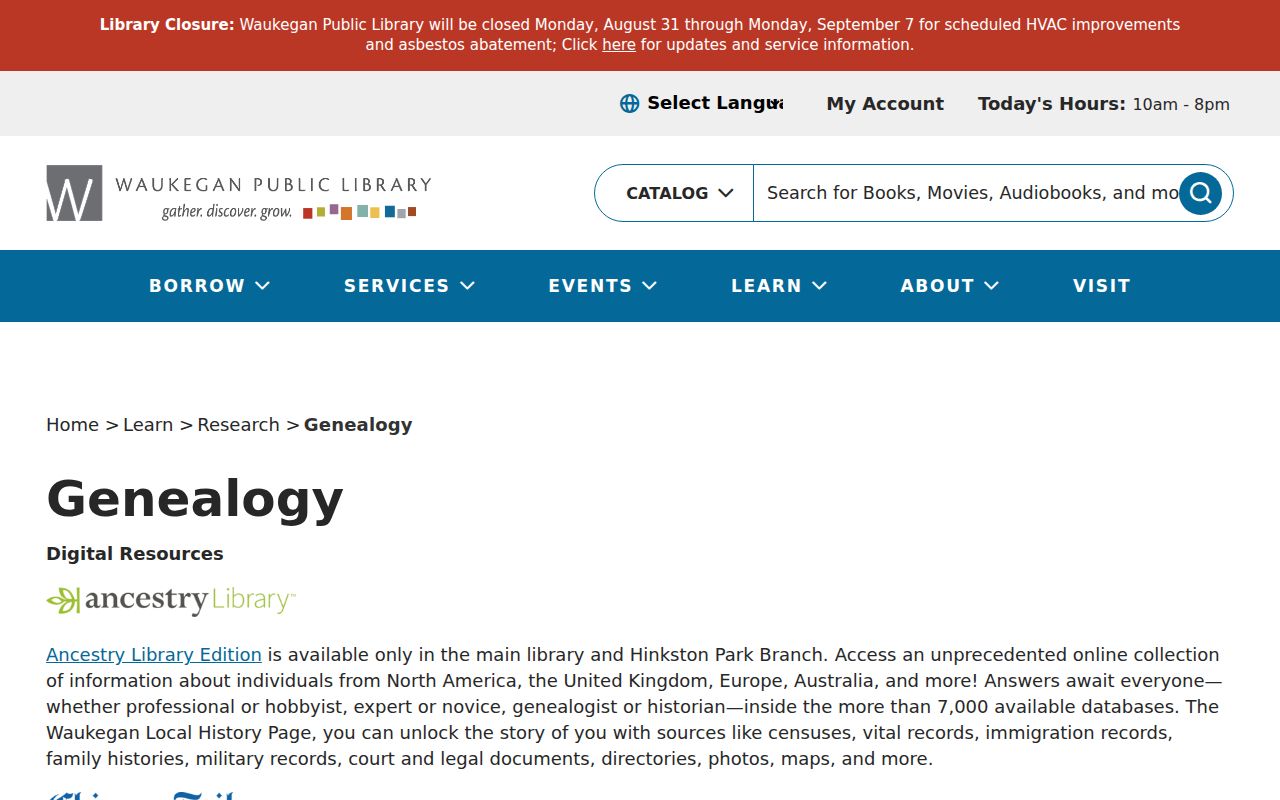
The genealogy capture shows the companion databases and newspaper routes used to confirm a directory name and date.
Vernon Hills Archive Alternatives
The Waukegan Historical Society holds photographs, manuscripts, ledgers, record books, maps, yearbooks, and published material. Its research room at the Waukegan History Museum at Carnegie lists Wednesday through Friday research hours and recommends appointments. Fees may apply.

The archive capture gives a direct contact path for material that is cataloged locally but not searchable as a city directory.
The Lake County History Archives at the Dunn Museum adds plats, school records, postcards, photographs, and local manuscripts. It is a place-history source, not a live people index. Ask a focused question with names, date range, and locality label.
Suburban North Directory Years
Library of Congress catalog records identify Chicago Suburban North or Far North telephone directories for 1959/60, May 1969, March 1971 through June 1972, and March 1973. The item pages returned an access error in unattended inspection, so exact page-level Vernon Hills coverage remains unresolved. This is a useful lead and an equally useful warning.
| Year | Catalog lead | What to verify |
|---|---|---|
| 1959/60 | LOC item usteledirec04939x | Village name, nearby locality, or exchange |
| May 1969 | LOC item usteledirec04949x | Alphabetic and street-oriented sections |
| 1971-72 | LOC item usteledirec04953x | Edition span and page label |
| March 1973 | LOC item usteledirec04956x | Vernon Hills inclusion and exact spelling |
Do not convert a catalog title into a claim about a person. A future manual review should capture the title page, contents, locality heading, entry, and page number.
Vernon Hills Names Beyond Directories
Small Lake County newspaper runs often bridge a missing city directory year. LCIGS identifies Little Fort Porcupine from 1845-1847 with gaps, Waukegan Gazette from 1850-1886, Daily Sun from 1897-1935, Lake County Independent from 1894-1919, Libertyville Independent from 1920-1929, and Libertyville News from 1932-1941.
Obituaries, legal notices, school news, advertisements, and community reports can explain a name or address change. They remain secondary evidence. Save the publication date and page, then compare the item with a deed, census, probate index, cemetery card, or directory edition.
Note: A clipping date may differ from the event date, and a newspaper spelling may differ from the formal record.
Trace Vernon Hills Family History
City directories work best as stepping stones between records with stronger dates or legal context. Begin with one well-supported name and place, then move one edition at a time. Keep unresolved gaps visible.
- Find the closest directory edition and save the title, year, page, name, address, phone, and area label.
- Check the prior and next available editions. Note moves, spelling changes, and years with no match.
- Use a criss-cross section, when present, to test the address and nearby listings without assuming a relationship.
- Pair directory years with census transcriptions, probate indexes, landowner maps, deeds, and newspapers.
- Close the trail with an obituary, cemetery card, vital index, or archive request, then mark the result supported or unresolved.
LCIGS census transcriptions cover 1840-1930, its probate index covers 1887-1949, and its landowner-map index reaches 1861-1915. Those dates reach far before Vernon Hills incorporation and can connect a modern place to older county geography. For a current address-keyed process, use the Vernon Hills street directory workflow rather than treating the historical shelf as current.