
Vernon Hills Address History Sources
No single roll lists every person who lived at a Vernon Hills address. Lake County deeds establish transfers, while tax and map records establish the parcel. Directories, census schedules, obituaries, probate files, school records, and newspapers may connect a household to the place. Keep the date with each result. A current portal view cannot prove an earlier fact.
| Source | Years covered | Where held | What it shows |
|---|---|---|---|
| Modern land index | 1980 to present | Lake County Public Search | Parties, dates, document numbers, PIN and legal text |
| Historical Record | 1841 to 1979 | Recording Division and Online Index Books | Handwritten names, book/page and early deed references |
| Landowner maps | 1861 to 1915 | LCIGS | Rural owners and geography before modern lots |
| Census transcriptions | 1840 to 1930 | LCIGS research room | Household names, ages and relationships |
| Suburban telephone books | Selected 1959 to 1973 runs | LOC catalog and libraries | Dated address and name leads, subject to page verification |
| Probate and obituary files | Varies | LCIGS, courts and libraries | Heirs, death dates and family links |
Start online for a post-1980 home. An older farm tract or pre-subdivision parcel usually requires index books, maps, plats, or staff help in Waukegan. A blank web search for previous residents is not proof that no record exists.
Start Vernon Hills Records With PIN
Use the current situs address, meaning the physical parcel address, as the starting point. Search the Lake County Basic Property Search, then note the parcel identification number, taxpayer label, assessment date, and legal description. A billing address may belong to a trust, agent, or owner who receives mail elsewhere. It does not prove occupancy.
Compare the parcel with county GIS layers for lots, subdivisions, roads, address labels, and historic tax maps. Those fields translate a street address into recorder terms. The Vernon Hills street directory gives the full current-address workflow.
Note: Save the source date, situs, PIN, and exact legal wording before following a name backward.
Trace Vernon Hills Previous Owners
The Lake County Clerk Recording Division keeps the legal document trail. Its regular index covers 1980 forward. A transfer identifies document parties, not all previous residents. Still, it gives the soundest route from today's owner toward an older one.
- Find the current PIN, situs, and taxpayer name in the assessor or GIS record.
- Search the address in Lake County Public Search, then repeat with the current grantee name.
- Record the purchase deed's grantor, grantee, date, document number, PIN, and legal description.
- Search the grantor as an earlier grantee to locate that party's purchase.
- Repeat to the online boundary, then carry the last sound name and book/page clue to Historical Record.
- Grantor
- The person or entity transferring an interest.
- Grantee
- The person or entity receiving it.
- Chain of title
- The linked series of recorded land transfers.
- Legal description
- Lot, subdivision, section, or land wording that can outlast a street label.
The Recorder Quick Search is the current entry point.
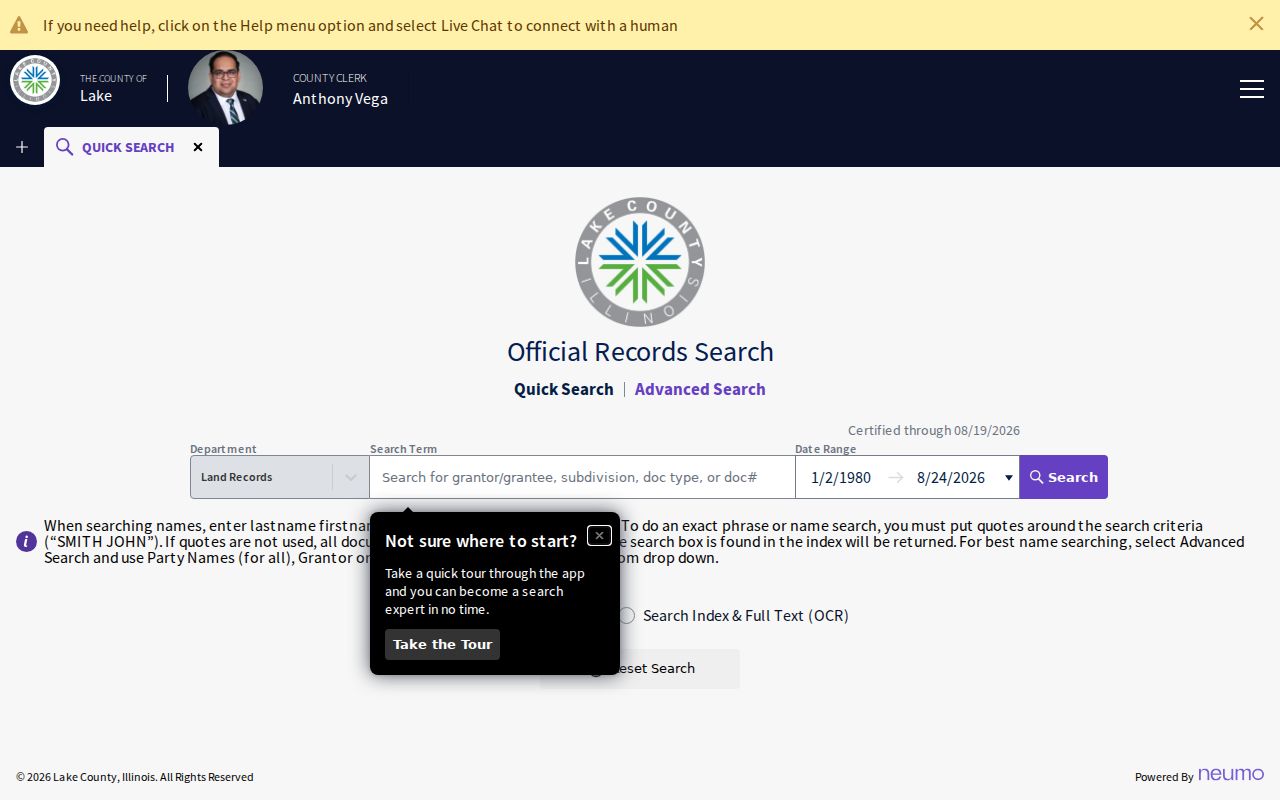
Treat each row as an index lead. Inspect the document and date before adding a party to an ownership timeline.
Refine Vernon Hills Deed Searches
Address spelling is often the weak link. Try full and short street suffixes, omit the unit, and search legal or subdivision text separately. Advanced Search accepts party names, dates, document types, PIN, property address, township, book/page, and legal-description fields. Begin broadly because initials, estates, married names, executors, and trusts can break a neat trail.
The advanced deed search exposes those filters.
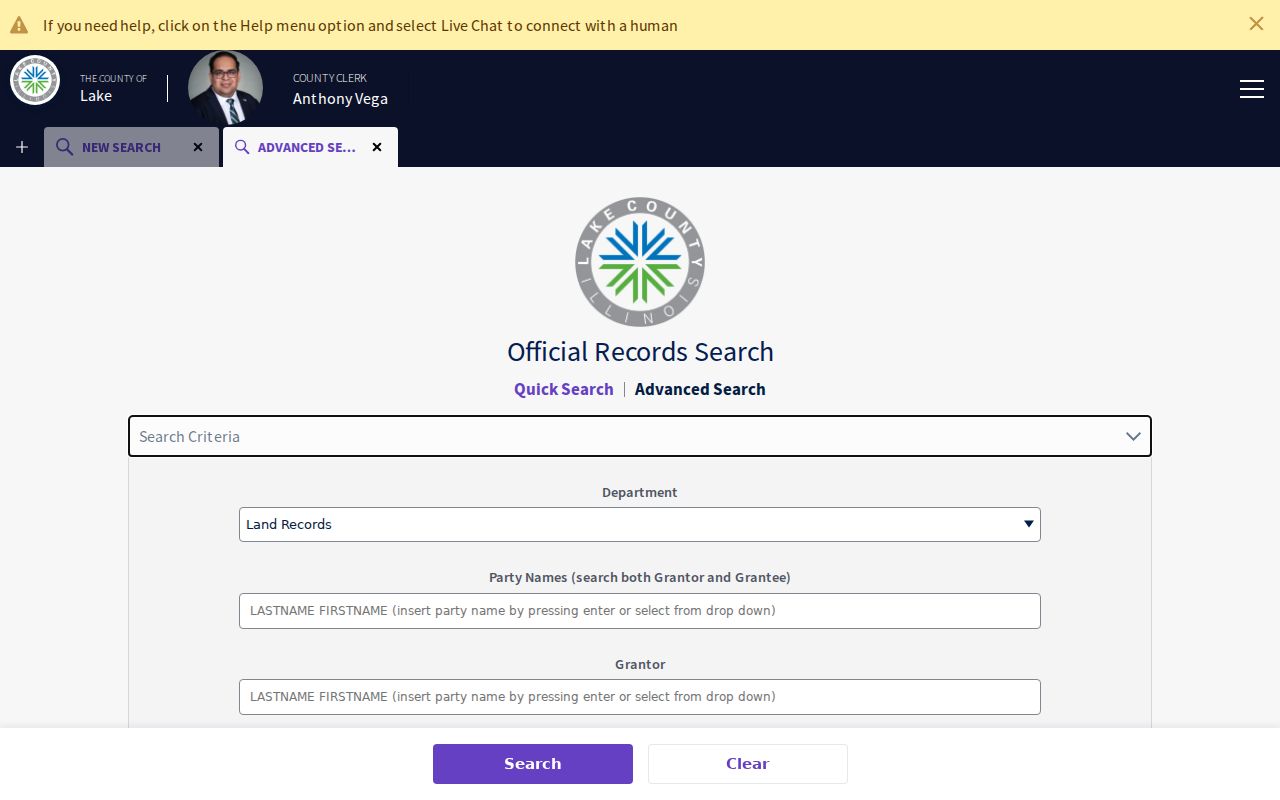
Use it after one deed supplies a verified name, PIN, or legal phrase. Index-only searches are cleaner at first. Full-text OCR may find an address in a scan, but handwriting and weak scans can hide it.
Vernon Hills Records Before 1980
The county has a sharp local cutoff: modern indexed land records begin in 1980, while Historical Record and handwritten Online Index Books cover 1841 through 1979. Carry the oldest modern grantor, legal description, document number, and book/page into that older trail instead of starting over with today's address.
Public terminals at the Waukegan office are available during county hours, and the county pamphlet says searching is free. Office copies are listed at one dollar per page. Online image costs can change. Mail, counter, and staff-assisted routes remain important when an image is absent.
Lake County's courthouse burned in 1875, but official history says the records were saved in an adjacent building. Old records may survive even though the building, index, and office arrangement changed.
Cuneo Land Became Vernon Hills
A new-looking street can sit on old land. The Village's Cuneo history traces the former Insull property through John Cuneo's 1937 purchase, Hawthorn Mellody Farms, closure around 1970, and later development near Hawthorn Mall, which opened in 1973. Other estate parcels entered Gregg's Landing development.
An annexation ordinance describes about 1,174 acres north of Illinois Route 60 between Route 21 and Butterfield Road and directs filing with both the Recorder and Village Clerk. A deed shows transfer, while an ordinance and plat explain how rural land became a municipal lot. Pair LCIGS landowner maps from 1861, 1873, 1885, and 1915 with GIS subdivision, lot, survey, and historic-map layers. They aid translation, not boundary proof.
Confirm Vernon Hills Past Residents
Owners are only half the story. No complete official Vernon Hills city-directory run was located. Older suburban telephone books may place the area under Vernon Hills, Libertyville, Mundelein, Half Day, or another exchange label. Preserve the title, year, page, spelling, and area label for every hit.
- Choose a year just after a recorded transfer and search the nearest directory edition.
- Compare the name and address with the closest public census year.
- Use newspapers, obituaries, probate, cemetery cards, school records, or yearbooks to separate same-name people.
- Grade the link as confirmed, supported, likely, or unresolved.
The Vernon Hills city directory collections cover the historical shelves. For previous residents, those sources test whether an owner was also an occupant and may reveal other household members.
Vernon Hills Genealogy Endpoints
LCIGS has a research room at 290 Evergreen Drive in Vernon Hills. Its holdings include census transcriptions, landowner maps, probate, birth copies, naturalizations, court files, cemetery records, yearbooks, and an obituary and cemetery-card file exceeding 250,000 items. Volunteer hours can change, so call first.
The county's genealogy index search provides another dated name check.
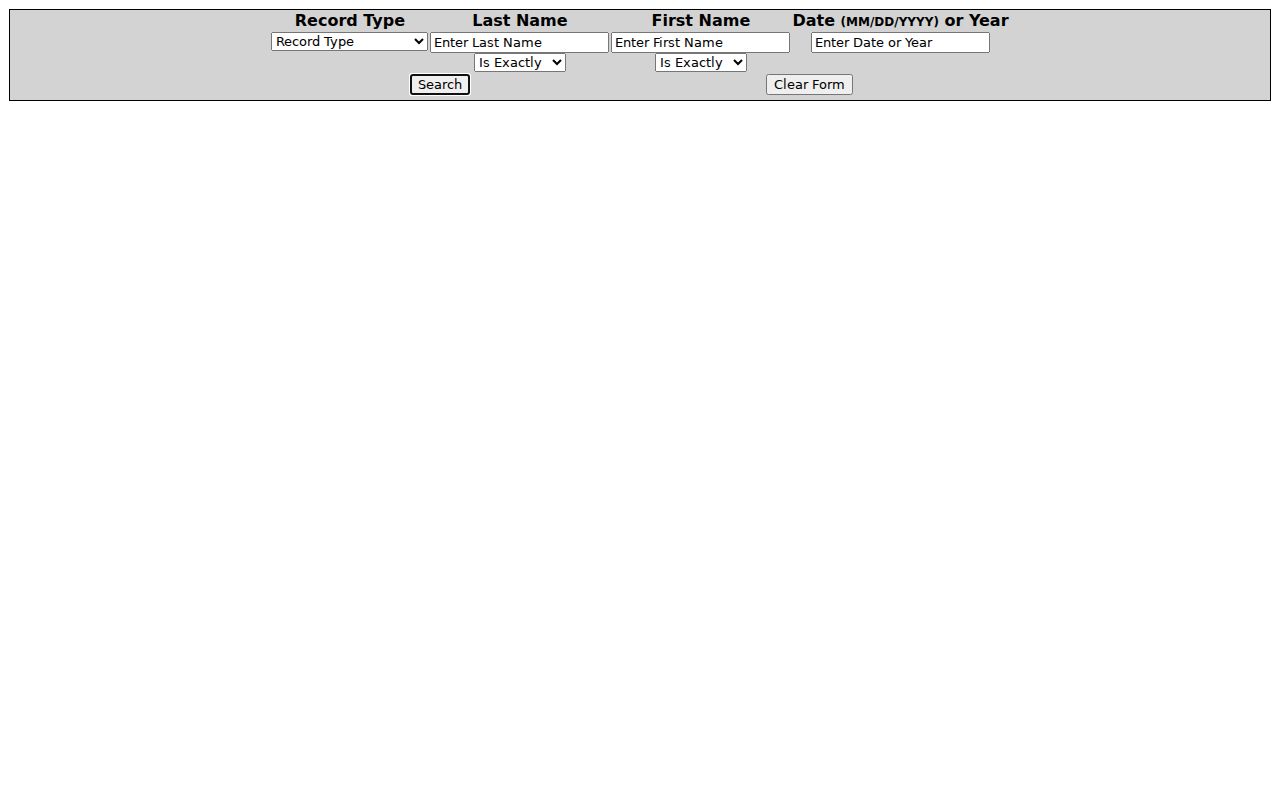
Marriage indexing starts in 1839, birth in 1871, and death in 1877. An index hit is a lead, not a certified record. Copy access remains subject to Illinois rules.
Waukegan Public Library adds directories, newspapers, microfilm, and a free obituary lookup. Probate indexes and court or archive requests can reveal heirs, executors, and estate cases.
Build a Vernon Hills House File
The official Waukegan house-history guide recommends deeds, tax records, maps, directories, censuses, wills, telephone books, Sanborn maps, newspapers, obituaries, photos, and oral histories. Sanborn sheets can show a building's size, material, outbuildings, plumbing, and electrical features where coverage exists. Verify the exact place and year.
Keep a source log with the address form, date, repository, title, page or document number, relationship shown, and conflicts. This keeps previous residents distinct from a taxpayer, trustee, heir, or directory subscriber who may never have occupied the home.
Lawful use. Research previous residents for house history, genealogy, estate work, or personal curiosity. Never use an address to track, intimidate, or harass anyone.
Request Missing Vernon Hills Records
A failed portal search calls for a better route, not a guess. For deeds and plats, contact the Lake County Clerk Recording Division or use its Waukegan public terminals. Give staff the names, date span, PIN, subdivision, document type, and any book/page reference already found. Ask whether the record sits in the modern index, Historical Record, or an Online Index Book. Request inspection first when the file may be large, then choose the pages that matter.
Village permit, zoning, ordinance, administrative case, and police records follow a different path. The Village does not publish an open permit or code-case index. A narrow Vernon Hills FOIA request should identify the property, record type, date range, and desired format. Keep permit files apart from police reports because different staff, exemptions, and copy rules may apply. Illinois FOIA is not a way around the special access rules for vital, court, or voter records.
Libraries and archives complete the fallback chain. Vernon Area Public Library can identify database access. LCIGS offers local indexes and volunteer help. Waukegan Public Library accepts obituary lookup requests and has local-history material. Waukegan Historical Society offers planned archive research, while the Dunn Museum's Lake County History Archives holds plats, photographs, postcards, and school records. State Archives and IRAD are stronger options for some old Illinois material. Before traveling, call to confirm hours, access, and whether the item must be requested in advance.